Two waterfront homes pop up in your search. Same "Key West, FL 33040" mailing address. Same turquoise canal in the photos. One is inside Old Town, one is on Key Haven, and the price per square foot is not close. Before you decide the cheaper one is the deal, look at which government answers the phone when you call about a permit.
Key Haven sits on Raccoon Key, a short bridge east of Stock Island. The post office calls it Key West. The building department does not. That single distinction is the mechanism behind almost every price gap, insurance question, and renovation timeline you will encounter comparing the two markets in 2026.
The jurisdictional line the post office ignores
The City of Key West spells this out on its own floodplain page. Several communities carry a Key West mailing address without sitting inside the city, and Key Haven is at the top of that list along with Rockland Key and the south side of Stock Island. If your home is on Key Haven and you need to talk to a floodplain administrator about substantial improvements, elevation certificates, or a downstairs enclosure, you are not calling city hall on Angela Street. You are calling Monroe County.
That routing decides three things that matter to a buyer:
- Which permit-allocation system controls new construction and redevelopment on your lot.
- Which floodplain office reviews any structural work valued above the 50 percent substantial-improvement threshold.
- Which set of local ordinances your title company will be reading when they check for open code cases.
None of these show up on the MLS sheet. All of them show up in the closing timeline.
Two permit systems sharing one ZIP code
The City of Key West runs its residential building permits through a Building Permit Allocation System, or BPAS. Monroe County, which governs Key Haven, runs the Rate of Growth Ordinance, or ROGO. Both exist for the same reason: a 1970s state mandate to keep the population low enough that everyone can evacuate the Keys within 24 hours of a hurricane warning. As Monroe County's own planning department describes it, ROGO is a competitive point system that steers permits toward parcels with infrastructure and away from velocity zones and habitat for endangered species.
The practical result is that a Key Haven teardown or ground-up rebuild is competing against every other vacant lot in unincorporated Monroe County for a shrinking pool of allocations. In 2012 the state issued 1,970 ROGO permits for unincorporated Monroe County to be distributed through the original 2023 deadline, and the county has stretched that pool by ordinance through 2026. A Key West Old Town renovation, by contrast, is scored against a different ledger inside the city.
For a buyer who is not planning to touch the house, this feels academic. It stops feeling academic the first time an insurer prices a policy on a home built in the 1970s with a below-flood-elevation ground floor, or the first time a wind mitigation report suggests you should be raising the structure rather than patching it.
What the canal is actually buying you
The reason people pay a premium for Key Haven waterfront in the first place is straightforward: the canal system was engineered wide and deep, with quick access to both the Gulf and the Atlantic. Listings on the Riviera Canal and the interior streets off Key Haven Road routinely show 70 to 80 feet of concrete seawall, 14,000 pound boat lifts, and canal depths sufficient for boats you would never keep behind an Old Town cottage. On the higher end you will find estates with more than 260 linear feet of water frontage on lots exceeding 15,000 square feet.
Compare that to what the same money buys on the city side. As of the current Key West market snapshot, waterfront homes in the city carry a median list price around 1.27 million with a median 124 days on market. In Old Town, the premium is paid for walkability, a historic-district address, and a specific architectural pedigree. It is not paid for beam clearance, turning radius at the end of your dock, or a straight shot out to Hawk Channel.
Here is the trade in one frame:
| Feature | Key Haven (unincorporated Monroe County) | Old Town Key West (city) |
|---|---|---|
| Permit system for redevelopment | ROGO, competitive countywide points | BPAS, city allocation |
| Floodplain office | Monroe County Floodplain Management | City of Key West Building Department |
| Typical boater profile | Deep-water canals, offshore-capable boats, quick Gulf/Atlantic access | Dinghy to mid-size, historic bulkheads, tighter clearances |
| Typical construction | Elevated concrete, metal roof, impact glass, 1980s to new build | Wood-frame historic, some restored conch homes, mixed elevation |
| Land per dollar | More lot, more seawall, more parking | Location premium, walkability, historic district |
The mid-market Key Haven buyer is generally paying for the boat, the lot, and elevated concrete construction. The Old Town buyer is paying for the street. Neither is wrong. They are different products under one ZIP code.
The redevelopment math you should run before you offer
Statewide numbers give you the mood, not the answer. Florida single-family sales rose about 2.5 percent year over year in April 2026, marking the eighth consecutive month of annual gains, and new pending sales climbed 8 percent, according to Florida Realtors. Median time from list to contract was 44 days. The statewide single-family median price sat around 425,000 at the end of May 2026. Those numbers describe the mainland. In the Lower Keys, and specifically on Key Haven, the market is behaving more like a scarcity trade than a rate-driven one.
The Keys inventory is finite, ROGO has metered new building for decades, and the state's designation of the Keys as an Area of Critical State Concern locks that in. When you buy on Key Haven, you are buying into a market where redevelopment is a queue, not a decision. That has three consequences worth pricing into any offer:
- A home that has been fully renovated and elevated already, with a documented elevation certificate, is worth more than the comps suggest because the next buyer will not have to enter the queue.
- A home with obvious deferred maintenance on the structure is worth less than the comps suggest, because "just tear it down and rebuild" is not a same-year plan under ROGO.
- A vacant Key Haven lot without an issued permit is a different asset class from a vacant lot with a permit in hand. Do not conflate them.
Downstairs enclosures: a 2025 rule change that matters here
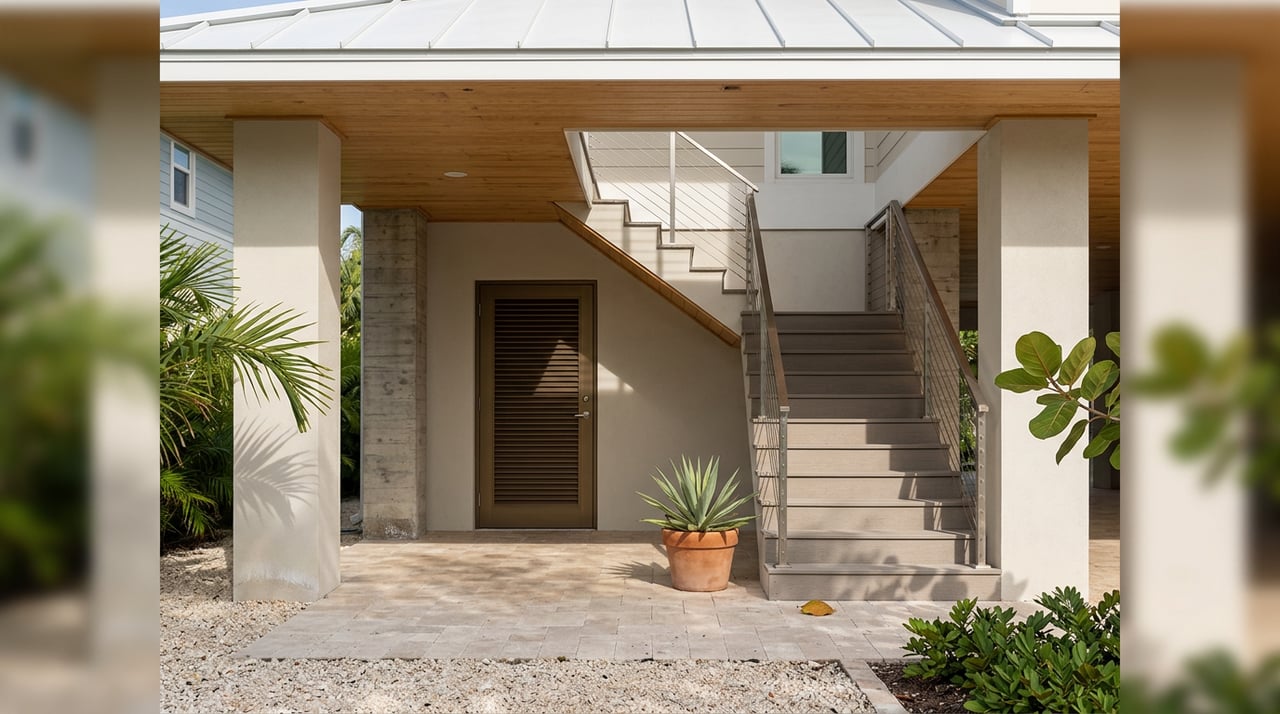
If you have toured Key Haven you have seen the classic profile: elevated main floor, garage or enclosed storage underneath, a set of exterior stairs to the front door. Under federal floodplain rules those downstairs enclosures cannot be habitable. Monroe County recently eliminated the longstanding 299 square foot limitation for enclosed storage space below elevated homes in unincorporated areas, and also removed the requirement for a downstairs inspection at time of sale. Owners expanding those enclosures still have to sign a recorded non-conversion agreement documenting the allowed use.
Two things follow for a Key Haven buyer.
First, that recorded non-conversion agreement lives on your title. A future buyer will see it. The house cannot be marketed as having more living square footage than the second floor and any lawfully permitted addition.
Second, homes on the city side of Key West operate under the city's own floodplain program, which uses different forms and a different reviewer. If a listing agent quotes you a "finished downstairs," ask which jurisdiction that finish was permitted under, and ask to see the paperwork. On Key Haven, the paperwork is countywide.
FAQ
Is Key Haven technically part of Key West? No. Key Haven has a Key West mailing address, but the community sits outside the corporate limits of the City of Key West in unincorporated Monroe County. For permitting, floodplain review, and code enforcement, the county is the jurisdiction.
Does Key Haven have HOA restrictions like a gated community? Portions of the surrounding area include gated pockets, but most of Key Haven proper is a standard residential neighborhood without a traditional homeowners association controlling exterior changes. County land development code is the primary constraint.
Why do Key Haven homes so often show concrete construction and metal roofs? Insurability and post-1990s Keys building codes. Elevated concrete, metal standing seam, and impact-rated glazing improve wind mitigation credits and produce meaningfully lower insurance quotes than legacy wood-frame construction sitting at grade.
Can I short-term rent a Key Haven home? Rental rules in unincorporated Monroe County differ from those inside the City of Key West and have been actively litigated. Confirm the current rules and any minimum-stay requirement for your specific parcel before you underwrite a purchase on rental income assumptions.
Ready to run the real math on a Key Haven purchase
The listings will tell you the price. The address will tell you the mail carrier. Neither will tell you which permit queue, which floodplain office, or which set of recorded agreements will decide what you can do with the house after closing. That is where a local advisor earns the fee.
If you are weighing Key Haven against Old Town, or comparing Key Haven to Cudjoe, Summerland, or Sugarloaf, Anneliese Dietrick can walk the specific parcel with you, pull the elevation certificate, read the non-conversion agreements on title, and tell you what the seawall, the lift, and the canal depth are actually worth in this cycle. Let's Connect.
