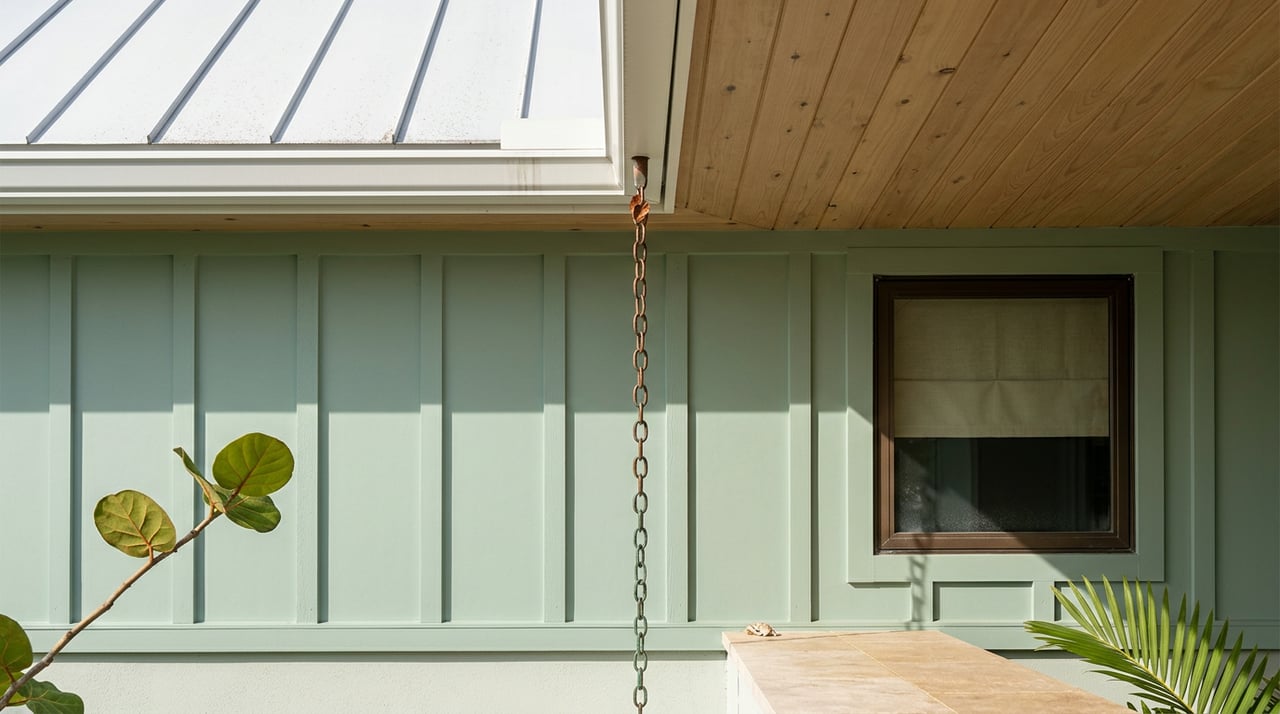
If you live on Summerland Key, you have almost certainly slowed down at the sign for 24244 Overseas Highway. Low profile, hurricane-hardened, a research campus tucked behind curated planting on the bay side of US-1. Most residents know it as "the Mote place." A smaller number know it by its real name: the Elizabeth Moore International Center for Coral Reef Research and Restoration, or IC2R3.
The building is not decorative. What happens inside it changes what you see when you drop a mask at Looe Key, and it quietly shapes the summer rhythm of the island you already call home.
What's inside a category-5 lab
The facility opened in 2017 and, according to Mote, was built entirely on philanthropic support. It was the first LEED-certified green building in Monroe County and was designed to withstand a category-5 hurricane. That last detail is not trivia. It means the lab is engineered to keep coral alive through the same storms that shape insurance quotes on your own home.
The scale of what is stored there is easy to underestimate from the highway. The Summerland Key campus is a LEED Gold-certified facility housing over 20,000 healthy coral fragments. Twenty thousand fragments is not a display tank. It is a working nursery, sorted by genetic lineage, that supplies replanting projects up and down the reef tract.
A short list of what the lab actually does day-to-day:
- Grows nursery corals from larvae, then tracks them once outplanted
- Studies genetic varieties for heat and disease resistance
- Houses the Alfred Goldstein Institute for Climate Change Studies
- Coordinates outplanting from Bahia Honda down through Key West
In 2017 Mote secured roughly $7 million in philanthropic donations to construct and launch the roughly 19,000-square-foot IC2R3, which includes the Alfred Goldstein Institute for Climate Change Studies on the Summerland Key campus. A milestone worth understanding as a neighbor: in 2020 Mote became the first scientific organization to complete every step of the staghorn coral sexual propagation process, and Mote-grown mountainous star corals outplanted to the reef reached sexual maturity and spawned in a record five years, the first time that has happened anywhere in the world.
That work is not happening in Miami or in a university 200 miles north. It is happening three miles from most Summerland docks.
The Tuesday morning that most residents miss
Here is the practical detail that turns the lab from an abstraction into something you can actually use. Mote's IC2R3 is located at 24244 Overseas Highway, Summerland Key, and public tours are offered Tuesdays at 10 a.m.
Ten a.m. on a Tuesday is a locals' window. Weekend visitors have gone home. The tour is not routed through a gift shop the way most Keys attractions are. It is a working lab that invites you in.
If you have out-of-town family coming down between Memorial Day and Labor Day and you want to show them something they cannot see anywhere else in the country, this is the answer that requires no boat, no reef trip, no reservation months out. It is a fifteen-minute drive for anyone living between Ramrod and Cudjoe.
Why the reef behind your house matters more this summer
The lab exists because the reef needs it. The summer of 2023 brought an unprecedented heat wave in the Florida Keys, with land heat records broken on 31 of the 62 days in July and August since record keeping began in 1950. That heat did visible damage offshore. The corals Mote is propagating on Summerland are the ones being outplanted to replace what bleached.
For someone who owns a home on a Summerland canal, the connection is not sentimental. Reef health is one input into water clarity, fish stocks, and the diving economy that determines whether guides like Capt. Nate keep running charters out of Summerland Marina. It is also one input into how the state manages the fishery your neighbors are getting ready for right now.
The 2026 mini lobster season falls on July 29 and 30, the last consecutive Wednesday and Thursday of July, with a daily bag limit of 6 per person in Monroe County and Biscayne National Park compared with 12 per person for the rest of Florida. The rule most homeowners on canals forget until they see FWC on the water: during the two-day sport season and the regular lobster season starting August 6, 2026, no snorkeling or diving is allowed within 300 feet of residential or commercial shoreline, including canals and marinas. If a houseguest wants to slide off your seawall with a tickle stick, they cannot. The nearest legal water is offshore, and the closest premier ground is Looe Key Reef, one of the most impressive coral reef systems in the continental United States, protected as part of the Florida Keys National Marine Sanctuary and known for healthy coral, colorful fish, and excellent visibility.
Which brings the geography full circle. The reef Mote is restoring is the same reef your visitors will be diving on July 29. The rules that keep them out of your canal exist so the fishery has a chance to recover. And the lab at MM 24.2 is where the recovery is being engineered.
The rest of the MM 25 corridor
The lab is the anchor, but Summerland is a working island in a stretch of maybe a mile that most residents already move through on autopilot. It helps to be reminded what is actually there, especially in July when the days are long and the plans are loose.
Breakfast is the easiest call on Summerland. The Galley Grill at 24862 Overseas Highway is rated 4.6 of 5 on Tripadvisor and ranked #1 of 6 restaurants in Summerland Key. Hours skew local: Mon-Fri 7 a.m. to 2:30 p.m., Sat-Sun 7 a.m. to 2 p.m. If you have not been in six months, you will still recognize the servers.
For a working pantry, Murray's Market at 24550 Overseas Highway runs 7 a.m. to 8 p.m. Monday through Saturday and 7 a.m. to 7 p.m. Sunday. This is the store you use when you do not want to make the Winn-Dixie run into Big Pine.
Dinner without leaving the island lands at Tonio's Seafood Shack & Tiki Bar, 25163 Overseas Highway, open Monday through Saturday 11 a.m. to 10 p.m. and Sunday 10 a.m. to 10 p.m. Tiki bar outside, air conditioning inside. It functions like a locals' room from about 5 p.m. onward once the day-trippers have pushed south.
The corridor also has one of the more specialized retail businesses in the Lower Keys. Ye Olde English Fly Shop sits at 24570 Overseas Highway and is open daily 9 a.m. to 5 p.m. A flats angler within twenty miles either knows the shop or is about to.
Stacked together, that is a genuine daily radius: coffee and eggs at 8, groceries at 10, a lab tour at 10, tackle at noon, and a hogfish sandwich at 6. Almost nothing on that list requires the causeway to Big Pine or the drive to Marathon.
A civic asset most owners have not priced in
When people talk about what makes Summerland different from Ramrod or Cudjoe, the conversation usually stops at deep-water access and Summerland Cove. Fair enough. Those matter to a buyer running the numbers on dockage and open-water routes.
The lab is the piece that rarely enters the conversation and probably should. Very few residential islands in Florida have a working research campus on the highway that runs through them, an institution positioned to keep the reef alive during a warming decade. Florida Keys coral reefs are the basis of a $6-billion annual economy and 71,000 jobs in Florida, according to Mote's president and CEO. The economic weight of a healthy reef sits underneath every dive charter, every fishing guide, and every waterfront listing between Marathon and Key West.
If you already live here, the argument is simpler. On a Tuesday morning at 10, you can walk into a lab that is quietly doing globally significant work and be back home in time for lunch. That is a benefit of the island you own that does not show up on any listing sheet and never will.
Ready to talk about your Summerland home
The reef, the lab, the corridor at MM 25, the canals behind Summerland Cove: they all shape what a home on this island is worth living in and what it is worth in a transaction. If you are thinking about a move, weighing an offer on your neighbor's canal, or simply want a straight read on the market from someone who lives it, Anneliese Dietrick is on Big Pine and one bridge away. Let's connect.
